AI transformation
AI use-case discovery, agents, workflow automation, proof-of-concept design and the data and operating foundations required for production.
An AI Transformation & Product Growth Consultant combining experience from Infosys Limited, Cognizant, Wells Fargo US, major financial organizations in the Netherlands and Databricks with a forward-looking focus on AI agents, product launch, PMF and distribution.
Book a free consultation call ↗


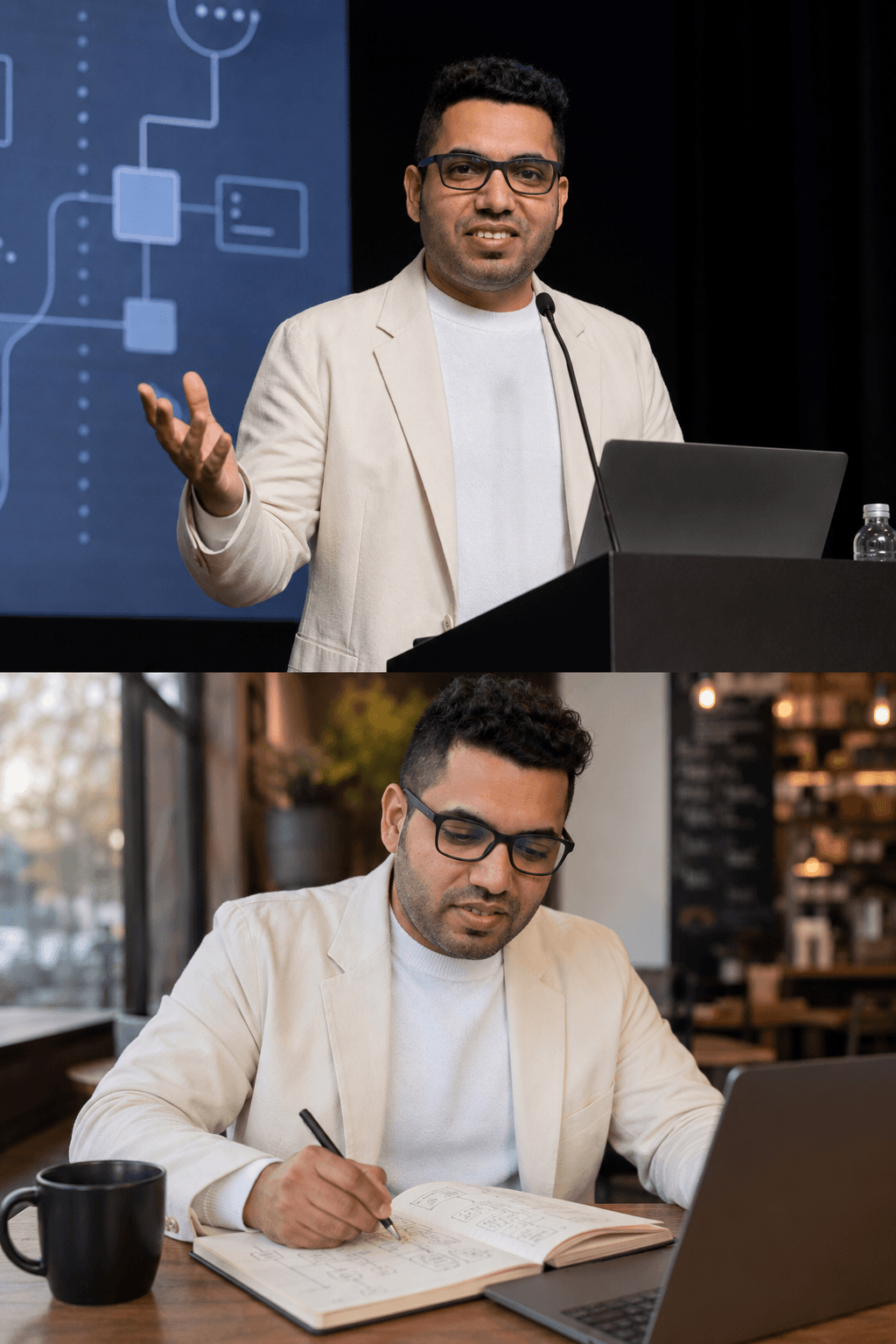

Close enough to the product to challenge assumptions. Technical enough to make the system real. Commercial enough to keep the market in the room.
From 2011 to 2018, the foundation was built through work with Infosys Limited, Cognizant and Wells Fargo US: Java and Spring platforms, production support, observability, database performance, secure delivery and large-scale data migration.
During 2018–2019, work with major financial organizations in the Netherlands expanded that view across Azure, AWS and GCP. The focus included infrastructure automation, Kubernetes, incident intelligence, chaos engineering, secure CI/CD and governance.
From 2019–2024, the work moved into Databricks-centred Data & AI as a senior specialist. The experience included contributing through a period when a smaller specialist team grew into a larger organization—bringing exposure to both focused delivery and scale.
From 2024 onward, the position is AI Transformation & Product Growth Consultant: helping founders turn AI use cases into products, launch them, learn toward PMF, build distribution and automate sales and marketing—without losing production reliability.
AI use-case discovery, agents, workflow automation, proof-of-concept design and the data and operating foundations required for production.
Customer problem definition, product wedge, launch planning, market evidence and iteration toward product-market fit.
Founder-led distribution, sales and marketing workflows, AI-assisted research, follow-up, reporting and feedback loops.
Ex-Databricks Data & AI, multi-cloud SRE, DevOps, observability, data engineering, security and production operations.
Technology choices should follow the workflow, users, constraints and business outcome—not precede them.
Reliability, security, observability and ownership belong in the architecture before a proof of concept becomes critical.
Automation is most valuable when the process is understood, controls are explicit and exceptions remain visible.
Clear scope, documentation, knowledge transfer and pragmatic technology choices reduce long-term dependency.
Strategy becomes valuable when the product, system and route to market move together.